Sunday, April 13, 2008

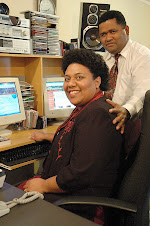
MEET TUBUKA RAIKACI OF BUREBASAGA, REWA

Tubuka Raikaci, who has been working at the Fiji Museum for 18 years believes success cannot be achieved without perseverence.
Mr Raikaci, 47, is originally from Burebasaga, Rewa and was brought up in his mother's village of Ravitaki in Kadavu. He attended Adi Maopa Government School for his primary school education before moving on to Lami High School.
He is married with five children. As a young boy he dreamt of either becoming an engineer or a sailor when he grew up, something he wasn't able to do.
Mr Raikaci started working at the museum when he was 30-years-old in 1990 where he worked as a cleaner and groundsman.
In 1997 he was given the opportunity to work as the conservator for artifacts at the museum. He said he coped with the added responsibility.
His responsibility was to look after the artifacts and objects preserved within the museum and he also looked after the laboratory where he does all his paper work and makes sure all objects are in good condition.
He said being a conservator was a really challenging job for him.
"My work is to make sure that all the artifacts that are preserved whether in storage or displayed are in good condition. I have to make sure that I handle them with care."
He also monitors and records other historical pieces that are brought to the museum. He said objects that are brought in to the museum are taken through certain tests and observation before approval is given for them to be displayed or kept there.
"I'm proud that I an doing something I wasn't taught at school. I feel experience has helped me in my work," he said.
"The main challenge in this line of work is to be creative in what you do. It is that creativity which keeps the tourists and people visiting the museum. It's all about how you preserve the artifacts well and how you are able to keep them in the same condition over a long period of time without any damage."
Through his years of working at the museum, he said there were times when he went through difficulties in life but he persevered.
"I have my ups and downs. What drives me every day is my family and the work that I'm doing," he said.
"No one is perfect. I believe all of us have problems that we go through in life. Everyone must go through struggles and difficult times to succeed in life." He said he enjoyed his work and that keeps him going every day. Travelling abroad, he says, helps him discover new ideas.
He makes sure to check the articrafts every day and fixes the ones that need to be fixed but this has to be recorded.
"This is like my home where I spend most of my time." Mr Raikaci believes if people have the heart to make an effort they will achieve what they want.
"We will also succeed in our work if we have patience and are faithful to what we do, because God is watching us.
"I feel blessed about what God has done for me in my work and for my family. I acknowledge Him in everything he has given me especially with the opportunity to have this job and I have to work hard for what he has provided me with."

VINAKA TUBUKA!


Adapted from Fijitimes Online

Saturday, April 12, 2008

MEET GINA JIT

GINA Jit believes you can do anything no matter what qualification you have if you have faith in yourself.
Many think that a good education and qualifications will get you a good job but Gina believes that it is not a matter of fact but how you can earn money from something you love doing.
The 30-year-old mother of +two children runs her jewellery business and caters for food.
Gina studied law for two years at the University of the South Pacific but could not continue her studies because her parents could not afford it.
"My dad is a retired mechanist and is a sickly person and my mom is just a normal housewife," Gina said.
"They don't get enough money to support our education."
Her dream of becoming a lawyer had to be shelved.
Gina said she understood her parents and came up with the idea of to start a business that would support her parents and family.
She started her business two years ago with $32 in her pocket.
Gina said from that small amount of money, her business was able to survive and she made a profit.
She followed the example of her grandfather who is a role model to her he started a business with three shillings and that, she said, was something which encouraged her to move on and pursue her business.
"I used to laugh and make fun when my grandfather used to tell me the story of how he started his business.
"But then I came to realise that if he could start his business with that small amount of money, I could do the same too.
"What made me start this business is that I believe not everyone can afford to buy expensive gold and pearl jewellery.
"At least, they can afford to buy the ones I make which have low prizes."
Gina said it was not a matter of being educated but what you could afford and how you could earn an income from what you love or enjoy doing.
She runs a food catering business and bakes cakes for birthdays, weddings and Christmas parties.
Along with the food business, Gina sells jewellery at cheap prices for the average people.
She earns $600 to $700 a week and the money goes toward supporting her parents, her family and helps her two younger sisters with their education.
She is also able to pay freight costs and duty for stuff which are imported from overseas for her business.
"I am going out of my way to provide a good education for my sisters.
"I want them to fulfil their dream with what career path they pursue.
"My advice to people is what talent you have, try and make something out of it in order for you to gain success.
"Just give it a try, you never know what you'll get.
"If you have your mind set on it then nothing is impossible for you to achieve."
Gina shows that a little faith can move mountains.


Adapted from Fijitimes Online

Wednesday, April 9, 2008

MEET KALYAN CHANDRA OF TAVUA

A FORMER Fiji teacher, now living in Canada, has been recognised for his outstanding contribution to the teaching profession in Canada.
Tavua-born Kalyan Chandra was among three other retired teachers who received the award this year from the Canadian Government.
He received his teacher training at Nasinu Teachers College and served in Ba, Tavua and Rakiraki.
He was also the principal of All Saints Secondary School in Labasa before he moved to Canada.

CONGRATULATIONS MR CHANDRA FROM THE FIJITUWAWA TEAM!


Adapted from Fijitimes Online

MEET ZUBER ALI, OF SUVA

Zuber Ali Azimullah (pictured) believes nothing is impossible if people obey their parents and believe in God.
Zuber, 21, who is the eldest in his family, has two sisters and one brother. He attended Suva Muslim Primary School before moving on to Suva Muslim College where he reached Form Three. He later spent one year doing vocational studies, before moving on to help his father in their family business.
Zuber said he left school because his father fell ill. He had to stay home and look after their cable business Maqs Cables.
"It was very hard for me to leave school at an early age especially when I saw my friends going to school but I had to do it for my dad and for the family," he said.
Zuber said his father didn't give him a choice to pursue another career because he wanted him to be part of the family business.
"When I was small, my dad used to tell me that I would have to work in our cable business which he started in 1991," he said.
He said even though he didn't like it at first, listening to his father's advice and respecting his instructions, he was able to see himself succeeding.
He never went through proper tertiary education but stayed home and learnt from his father and now he is running their family business, specialised in manufacturing, designing and repairing cables.
"I learnt from him. When I was in school, sometimes I couldn't do my homework. It was different in the workshop where I helped my father out. That's how I learnt this job."
He said the most important people in his business were his customers and he would try to meet their needs everyday.
"I make sure I provide them with what they want. I can do any kind of cable even if it's difficult, I would try and do it for my customers."
He believes God was always there for those who tried and would always be available for guidance and provision.
"All we have to do is to trust God and never give up hope," he said.
"As it happened to my dad and me, I'm sure good things can happen to anyone who believes in Him."
Zuber said he was able to overcome difficulties in life which allowed him to learn new things. He said he has never regretted following his father's advice and would continue to hold up the name of their family business.
Zuber advises young people to listen to their parents and serve God.
"There are only two things I would recommend for young people nowadays. Obey and listen to your parents and serve the Lord with a good heart. Without God we won't be successful and He is the only ally we can count on."


Adapted from Fijitimes Online

Monday, April 7, 2008

MEET ANA TUIWAI OF LOMATI, KABARA, LAU

Ana Tuiwai is defying the odds by becoming a certified diver. The 27-year-old was born and bred in Lomati, Kabara, in Lau.
Third in a family of four children, Ana had wanted to become a deaconess.
Her parents Filimone Tuiwai and Joana Vakaturituiwai were farmers who worked hard to give their children an education.
For Ana, doing household chores and fishing every Saturday was the life. She never thought she would do something like scuba diving. Ana said unlike urban areas, money, or the lack of it, was hardly ever a problem in the village.
She said the village was full of life and providing food for the family never a problem.
"In the village, only the boys did diving. I used to help my mother out with chores," she admits.
"I even used to weave mats and help cook. I remember every Saturday I used to go fishing and I really enjoyed it.
"In the city if you don't have money, you can't buy food but in the village if there is no money, food is readily available either from the sea or from our plantations.
"I never thought of diving professionally because only the boys did that. For us girls, we were supposed to do normal things that girls did. I was a very spiritual person and I wanted to become a deaconess."
She attended Kabara District School and came to Suva for her secondary education, attending Form Three at Suva Sangam High School.
In 1995, she left school and went back to the village.
"I left school because I was not interested anymore. I stayed with my aunt when I was in Suva and went back to the village after Form Three. I feel life in the village is very easy.
"In 2004, Frances Areki from the World Wildlife Fund came to Kabara to do something on the vesi.
"That's when I first heard about WWF. The following year, Monifa Fiu from WWF came to the Kabara and wanted to me help with surveys on the reef and sea grass. She stayed with my family. So I agreed to help her.
"I learned a lot like the English names for different kinds of fish. I only knew the Fijian names. I learned how to do coral reef and seagrass surveys."
Later that year, she took part in a WWF-sponsored dive training at Dravuni, Kadavu.
She said her father was not too enthusiastic about it because he felt diving was too dangerous for her.
"Even my brother in England was not enthusiastic about it too. They told me diving was dangerous but I wanted to try it and I wanted to do something interesting. Later they supported me.
"The dive training at Dravuni was for a week and I was the only girl learning how to dive and conduct reef and seagrass surveys.
"After the training, I became a certified diver and I felt very happy because this was something done only by boys in the village.
"In 2006, I was the only WWF diver from Kabara. I later joined the Wildlife Conservation Society and worked on projects including dive training in Macuata, Kia and Macuata-i-wai."
Ana has become a WWF volunteer and helps in dive training for island youths.
She said she had always believed in her strengths and talents, something she will always be thankful for.
"I feel so proud and happy to be a dive volunteer with WWF because I have shown that not only men can dive.
"The diving skills I have learned are useful for finding employment in tourism.
"Whenever I am helping with a dive training session, I feel like one of them. The boys, I believe I had the eagerness and enthusiasm to succeed," she said.

Adapted from Fijitimes Online

Sunday, April 6, 2008

MEET GAVIDI TURUVA, OF TAVUKI, KADAVU

FOR Gavidi Turuva, giving children from broken homes another chance at life is a satisfaction she gets to go home with everyday.
In her view, all children are unique and precious gifts.
She feels today's community is missing out on many issues concerning children.
"We are missing out a lot on children's issues which we think is very small especially in the community," she said.
"It's every parent's duty to take care of their children."
The 50-year-old counsellor said sharing her experiences with children who come from such backgrounds "helps both sides find solutions that will work in the child's favour".
She started doing counselling by helping out in the community as a young girl growing up in Ba.
"I started in this career path because I love working with children," she said.
"I was brought up in a very big family. My interest in working with children goes back to when I was in school at Saint Theresa's, which at that time was run by the nuns in Ba. After completing primary education I went on to Xavier College before trying to find my footing in my career path.
"What really made me more determined to look after and care for these children is that I had been adopted myself. I am able to share my views and experiences with these children."
Gavidi hails from Tavuki, Kadavu, and has been married since 1979. She has three grown children whom she is very proud.
"I have been doing community work with the Soqosoqo Vakamarama for the past 10 years," she said.
She said the National Council of Women opened a counselling office but the military takeover of December 5, 2006, closed it.
In stepped the Soqosoqo Vakamarama Saunaka branch, which took over with the blessings of the Taukei Naua, Ratu Ponijese Lou.
"When I joined the National Council for Women, I underwent courses with the Fiji Nursing Association and with our counterparts from Australia known as Child-Wise from Victoria State in Australia.
"The course was from 2001 to 2005. The workshop focused on health issues and was one way we are trained to find out how we can combat crime, sexual abuse, HIV/AIDS and marriage breakdowns."
Gavidi said parents had to do their homework from the very beginning. She said it was an enormous task to educate children on what married life would be like and that she found the biggest abuse in the community was neglect.
"For many, it's as long as you can see a child walking we send them to the shop on errands.
"I believe if we all do our homework and pay more attention to our children, we will be crime-free, no diseases."


Adapted from Fijitimes Online

MEET ULAMILA BULAMAIBAU OF VANUASO, GAU, LOMAIVITI

ULAMILA Bulamaibau believes success is all about taking the risk and wanting to experience life.
The former manager training for the Fiji Development Bank is the executive director of the Society for the Prevention of Cruelty to Animals.
Originally from Vanuaso on Gau, Ulamila joined SPCA this year. Her late father Ratu Kulanikoro Qicatabua Bulamaibau was a civil servant.
She said her mother Sesarina Elina did the most important work of being a wonderful mum. Born in Suva, Ulamila went to primary school in Suva but went to secondary school in Lautoka.
Being an only child, she learnt to be independent especially having to keep busy with favourite pastimes. She said apart from normal everyday life, she was able to withstand hardship.
"The only child in the house meant having to occupy oneself or amuse oneself with pastimes that one could do independent of anyone else.
"These included activities such as reading, drawing, colouring, climbing trees in the yard and collecting stamps. There were moments with the neighbours children.
"It made me accept challenges as they come. I was taught to work hard, not to waste and also to appreciate what I am given.
"My father was a disciplinarian. When I was young, I wanted to be a number of things.
"This kept changing and now when I look back, I think it is really funny because I have obviously gone far away from those initial thoughts.
"Sometimes it has to do with the glamour of the job, pressure from family or the way society sees a type of job that influences the way young people think about what they should or should not do. But I never thought I would be where I am today."
She went to Gospel Primary School for less than a year before finishing off at Jasper Williams in 1981. She got her secondary education at Jasper Williams High School and on to the University of the South Pacific where she obtained her Bachelors degree. In 1990 she joined the FDB as a research officer and worked her up to be a top staff before her move to SPCA.
A thought on many people's mind is why the move from a well-paid job at FDB to join the animal care field.
"When the position became vacant I thought about it but not that seriously. On the other hand, I had also been seriously thinking about what I was doing and whether it continued to excite me or challenge me in an interesting way.
"I started to think of whether I could do something that was really meaningful to me and was real, something that would make an impact. I knew that it was time to move out of my comfort zone and make use of my experience.
"I wanted to learn and work in the field of animal welfare. All the while, I had the backing and encouragement of a close friend who believed I should take up the challenge.
"That encouragement and support helped me in making the final decision."
She said the interest in animals was always there. Ulamila said they had pet dogs who were her reliable friends.
"I like having them around. They were always there. Even now, I always feel that pets are always there, they are tough and they never give up on you, even when they are sick.
"They are always there to welcome you and follow you to the shop if they can. Some of the benefits of the job are working with animals who are God's creation, helping make a difference for animals though SPCA efforts and meeting people who share or contribute to the efforts of animal welfare.
"For me, it is comforting to know that one is not alone in the battle against cruelty to animals. The Creator is the biggest inspiration in my life because he works in mysterious ways and there are things that after it has happened I wonder, well how could that be possible?
"It makes the struggle worth the effort especially in the field of animal welfare, when one knows there is someone out there looking out for you."
Ulamila said there were a lot of opportunities for those wanting to join SPCA. Her advice to students is weigh the possibility of studying veterinary science.
She said this was particularly useful in a country such as Fiji where there are only a few veterinarians. She said SPCA needed people who share in its vision and goals and most important, those who are passionate about animal welfare in Fiji and can do something about it.
"In life, there are regrets and there are times when one tastes success. It is all about taking risks and wanting to experience life by taking and giving back something to this world and life.
"Joining SPCA, for me, was all about that," said the optimistic director.


Adapted from Fijitimes Online