Saturday, May 31, 2008

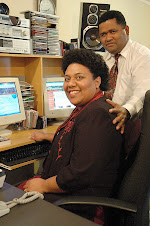
MEET MERE SAGAITU OF EKUBU, VATULELE NADROGA

WHEN a person has been blessed with special talents, enabling them to do wonders with their hands, they should not neglect that, says masi maker Mere Sagaitu.
She believes if anyone was blessed with special talents they should put it to good use otherwise that talent will be taken away from them.
"Everyone has been blessed with a talent and they should put it to good use and not sit idle if they do not have any form of employment to either support themselves or their families," she said.
In Mere's case, masi making has always been in her family genes and her one passion in life.
The mother of three hails from Ekubu, Vatulele, while her husband Petero Sagaitu, hails from Sawaieke, on Gau.
Mere, as she prefers to be called, recalled her days as a young girl on Vatulele when she used to help her grandmothers prepare the inner bark of the mulberry tree for the masi.
She said as she got older she went on to complete her secondary education at Dudley in Suva after completing her primary years on the island of Vatulele.
"After I finished high school I stayed at home with my parents in Sigatoka before deciding what I was going to do with my life," she said. I learnt masi making through my grandmothers when I was growing up in Vatulele.
"This skill or talent as one may call it has remained with me because any free time I had, I used to try it out."
Mere said she loved masi making and would not swap it for anything else.
She said the inspiration for her to start her own business came about after she got married.
She said at the time she decided to start her own business, her husband who was a miner with the Emperor Gold Mines in Vatukoula, was one of the few who had opted to take the package back in 1991.
"Looking back, I can say the journey has been a long one," she said.
"My husband and I had decided to start our own masi making business for ceremonies like weddings or house decoration."
Mere said since starting out the business, orders have been coming in from major tourist shopping outlets.
She said she has also employed other women in the area to help beat the mulberry bark to prepare the masi.
She said although it was a tiring job the returns were worthwhile.
She said the pieces range from wedding suits, to birthday outfits with prices to match.
"It's going to be an even longer one now that I have actually gone into selling my masi," she said.
Mere said the other positive thing to have come about from starting her own business was that she now teaches masi making to students who visit her requesting to learn.
She said by entering the masi making business she has been able to also meet up with her business contacts.
"Last year during the Christmas art display in Suva I was approached by the Pacific Cultural Centre in Hawaii to do some masi work for them," she said.

Adapted from Fijitimes Online

Friday, May 30, 2008

MEET LIDIA RAIBEVU OF NABUKAVESI, NAMOSI

Imagine living in a one bedroom house with 18 relatives to look after. Life would definitely be one of hardship and difficulty especially when there is only one breadwinner in the family.
For 32 year-old Lidia Raibevu (pictured), having a home of her own had been a figment of her imagination for the past four years.
Lidia and her husband, Waisake are part of Project 30/30 headed by non-profit Christian organisation Habitat for Humanity. The home build project involves building 30 homes in 30 weeks for 30 low income earning families.
Originally from Nabukavesi in Namosi, Lidia is third in a family of seven children.
Her late father, Avenai Waqilau worked as a clerk for Carpenters Shipping while her mother Mere was a housewife.
Lidia had always wanted to join the police force. For her, being a policewoman was inspiring, especially the fact that the duty of the police force was to help and protect people.
"We had a simple upbringing but even life then was not an easy one. We lived in Lami and life there wasn't easy especially living in town. There were a lot of expenses but my parents worked hard to provide us with a good education. We lived close to the sea and I remember my mother used to catch and sell fish for a living.
"I had a strict upbringing but it helped build my character. I had first wanted to be a policewoman because I loved the uniform they wore. I think the feeling of wanting to help others was inspiring enough and besides I grew up next to a police station."
She attended primary school at Marist Convent in Lami. From 1990 to 1994, she continued her secondary education at Cathedral. After high school, she decided to find a part time job as a waitress.
She then moved on to join Carrodocs Investment as a sales agent. Although being involved in sales and advertising, Lidia always maintained her desire to don the police uniform.
"I worked as a part time waitress for two years. I moved on to work as a sales agent for Carrodocs Investment. We sold all types of goods to different wholesale and retail companies.
The business went into bankruptcy so I joined Private Seas hotel and the Travel Inn. I worked there as a maid and receptionist.
"I still had that feeling inside to join the police force. I wanted to help people. In 2000, I was asked to be a volunteer teacher at Marist Convent Primary School. I was very happy working as a volunteer teacher for Class One students. I love children. I had a daughter when I was 19 years old and she lives with my parents. I never thought I would teach even as a volunteer. The experience was very educational and motivational."
She was also part of the Catholic Women's League, a non-government organisation which is part of the National Council for Women.
Her membership in the organisation allowed her to participate in workshops on various issues in Fiji. In 2001, she joined the police force.
She completed the required training and after months of dedication and commitment, she finally achieved her dream.
"The minute I put on the uniform, I felt my dreams had come true. I was a special constable in the force. The following year in 2002, I married my husband who is a policeman. I left the force and joined Dauniyau ni Yasana women's group as their treasurer. I resigned from that position last year and stayed home to look after my four year old son. My husband is the sole breadwinner in the family and even though times are hard, I always have faith and trust in the Lord.
"I believe I have achieved my dreams. I am happy that with the help of Habitat for Humanity, my family will have a house to call our own. The secret to achieving one's dream is to have a good education and to work hard. That is the only way up the success ladder," she said.

Adapted from Fijitimes Online

Monday, May 26, 2008

MEET SEMI KOROILAVESAU OF NALOTU, YAWE, KADAVU

When growing up in Nalotu, Yawe in Kadavu, Semi Koroilavesau never dreamt that one day he would be a naval officer, forget being a director of a prominent cruise company.
Being the boss of the Captain Cook Cruises and travelling to nearly all the countries in the world was a far cry from his life at Nalotu.
He had made a name for himself in not only the cruise shipping sector, but also in the naval division of the Republic of the Fiji Military Forces where he finished of with the rank of a Commander.
He is also a chairman of the Fiji Ports Corporation and is a qualified sea captain.
He said he was now enjoying the fruit of the sacrifice and the teachings of his parents, some of his teachers and the determination he had earlier in his younger days.
But the way to get there was not smooth sailing for Mr Koroilavesau who is commonly known as Commander Semi.
Life definitely did not come on a silver platter for him.
With seven siblings, his younger days were full of struggles, having to share whatever little they had.
But he said it was the strict upbringing from his parents that directed him to a good path in life.
"My father was a disciplinarian and my mother was caring and loving," he said.
And they were devoted Methodists who always ensured our faith was intact.
He said even though life in the village was the happiest thing he could think of, money was hard to obtain.
"My father had to struggle to support the family especially when there were eight of us," he said.
His father was a handy man at Richmond High School, who emphasised on education for all his children.
Commander Semi said since his father was a handy man, he and his siblings were able to get free education at Richmond.
Since they were staying at the Richmond School compound, he had to walk for about two hours to get to get to his primary school - Yawe District.
It was a two hour walk in the morning and another two hours back.
That went for six years from 1963 to 1968 until he passed his Fiji Intermediate Examination
That was a big relief for him as he would no longer walk long distances, because he lived in the school compound.
At Richmond, he used to help his mother sell food to the other students to get additional income for the family.
"My late mother used to make roti parcels and I helped sell it to the teachers and students," he said.
Commander Semi said his grandmother, a skillful handicraft maker, also contributed towards the family upkeep.
And every Saturday, he had no choice but to help his father at the plantation.
"We used to go in the morning and come back late in the afternoon," he said.
"That was something I dreaded and my father often reminded me that was what life in the village was all about.
"He told me that if I do not want to live that kind of life, I must study hard and try to get a good job after school," he said.
With determination and a strict upbringing Commander Semi was able to pass his Fiji Junior Examination in 1972 and secured a place at Lelean Memorial School.
"I boarded in Lelean from 1973 to 1975," he said.
Although life at boarding school was not easy, it was fun, he said.
Knowing very well the difficulties faced back at home, Commander Semi told his father to only give him his school fees and he would work for his pocket money.
"Me and the other students from the islands used to go to Indian families in Davuilevu and neighbouring areas and work for them on Saturdays after our chores from the hostel," he said.
"That's what you call kam-karo," he said.
He used to earn about $2 to $2.50 for cleaning their gardens and raking their compounds.
Commander Semi said that time there were a lot wild jackfruit at Davuilevu.
"We used to get that and sell them to the Indian families that we went to for 75 cents," he said.
"That was extra money for us."
He said the money was enough for their movies at the Regent in Nausori plus half a loaf of bread and butter.
"That time, we always ate kadrala (hard cassava), so the money we got, we bought our bread," he said.
He said one of the teachers then, Autiko Daunakamakama really moulded him well during those days.
"He is someone I always look up to," he said.
After passing Form Six, Commander Semi had a choice of whether to go to the University of the South Pacific or joined the military.
"Since I was not so disciplined that time with big hair and no care at all of how I looked, I thought the military would be the best place to get the discipline that I lacked," he said.
So he went for the officer cadet course in January 4, 1976.
He went to the naval division the same year and he stayed there for 18 years.
He was one of the two officers who started Captain Cook Cruises in 1988 while he was still in the military, but had to resign in 2003 to pursue his business dreams.
Commander Semi is married to Joanne, who is now his operations manager.
He has five children - his eldest son Alifereti is a naval officer and he is away training in Malaysia.
His second son Lars, a former navy personnel, is an engineer for Captain Cook Cruises.
His only daughter Ballina is in the US Air Force and two of his younger sons are also in America.
His youngest son is at home in Nakurakura and attending Nadi Airport School.
He has two grandchildren - Ballina and Josaia.


Adapted from Fijitimes Online

MEET ELINA NAIKELEKELEVESI OF VANUA LEVU

Her husband, Sireli, may be one of Fiji's top athletes but Elina Naikelekelevesi (pictured) has a reason to shine on her own.
The 31 year-old physiotherapist is the coordinator for the CAL program which focuses on competency based training, assessment, consultancy and community solutions. It is basically an early intervention training program for teachers, parents and caregivers of children with special needs.
Elina grew up with a medical background. Her father, Semesa Matanaicake, was a doctor. The eldest of seven children, her life has been one of many travels. Her father's profession as a plastic surgeon meant travelling to New Zealand and the United States of America.
Her mother, Ilisapeci Qelemumumu, is from Vanuabalavu and her father is from Vanua Levu. Elina said her cooking skills kicked in when she started Form One at Suva Grammar School after attending primary school at Veiuto. She continued part of her primary education at Cornwall Park District in Auckland.
"I had a very happy and blissful upbringing. My father was a doctor so we grew up in the staff quarters. My mother used to work at Morris Hedstrom before she married and afterwards she stayed home to look after us. In fact, my mother is my mentor in cooking. She was the one who taught me how to cook.
"I used to hear my friends say they could cook this and that so I decided to learn how to cook. Even in secondary school, I took home economics so I learned to better my cooking skills there. Sometimes, I would help my mother around the kitchen. This particular watercress and tuna salad is one I usually make at home. It is a healthy salad either for lunch or as a side dish."
Another option Elina usually goes for is whisking lemon juice, a drop of soya bean oil, salt, sugar and pepper with vegetable from the fridge. She says fresh tomatoes would also add flavour and taste to the salad mix.
Toast on the side is an added bonus to the salad although this would be a proficient way of making use of left over bread. Like most medical professionals, Elina believes good food whether vegetables or bread should not go to waste.
"I make a lot of things from left overs like this salad for instance. A combination of bean sprouts, lettuce, watercress, cucumber, carrots and even apples. The toasted bread with butter is an option for many otherwise on its own it is also healthy.
"I spent Form Five and Six at Adi Cakobau before doing part time foundation studies at the University of the South Pacific. I wanted to study what my father studied but I was not as smart as my dad. So I opted for other fields like pharmacy but at the time the Fiji School of Medicine was not accepting new intakes. The next option was physiotherapy. My mother was a very strong person. She was the one who pushed me to take on physiotherapy," she said.
She then continued her education at FSM before working three years at the Colonial War Memorial Hospital as a physiotherapist. Elina was then transferred to Rewa subdivision hospital in Wainibokasi.
In 2002, she married Sireli Naikelekelevesi who she met during one of his occasional training routines past her home on Suva's Extension Street. For Elina, physiotherapy is not only massaging people as most people would think. It is more of a hands-on job, interacting with patients and finding ways to help them or ease their pain. She said physiotherapy also deals with exercising as part of a treatment technique.
The mother of four believes anyone can achieve their dreams if they work hard, persevere and pray. One of her highlights was being a member of the medical team for the national basketball side during the South Pacific Games in 2003.
She was also the physio for the Tailevu rugby team and the Rewa soccer team. In 2005, Elina was the physio for the national netball team to the Commonwealth Games in New Zealand in 2005.

Adapted from Fijitimes Online

MEET SULITA DUGU OF NAROQALI, MACUATA

IF you are a career woman, it can be hard managing your work and family, especially when you have 12 children.
But as the saying goes behind every successful man is a strong woman in Sulita Dugu's case, she had the support of her husband who made life a whole lot easier.
Sulita is the deputy headteacher at Holy Family Primary School in Labasa, Vanua Levu.
Her story about growing up in the interior of Macuata province, her journey into boarding school until she became a teacher reads like a bestselling biography.
Second in a family of four children, Sulita often played the role of eldest because her older brother was brought up by an aunt.
Her parents were simple villagers and farmers but her father worked hard for their future.
Her father Aisake Matayau went to Navuso Agricultural School to learn about tilling and planting the land.
He returned to the village after Navuso and started a dairy farm.
"We stayed on a farm near Nacaurokovi Village but the village had to relocate so the people could be near the main road.
"The actual village was called Naroqali and it was in the interior between Savusavu and Labasa.
"The new village site was near the main road for convenience.
"My father received limited education but he was able to apply the knowledge of agriculture he learnt at Navuso to start a farm.
"The cattle farm did not work out though because some people in the village said our cattle were polluting the water so my father stopped it and started a chicken farm.
"That too did not turn out well so he switched to yaqona and dalo farming.
"I remember watching my father waking up early in the morning to take dalo and grog to sell at the market.
"He used to walk in the dark with his kerosene lamp.
"The main road was far from where we lived and my father did all that to support us."
With her father's daily routine to the market, Sulita said they and their mother spent most of the time living alone until he came home.
She said her father would come back late at night from the market but they would eagerly be waiting for him and whatever goodies he brought home.
She said her father was a disciplined man and always stressed to them to go to school and work hard to get a better life.
"He did not want us to struggle in life as he did.
"The place we lived in was called Senitebe and our home was a Fijian bure.
"Everything in the village was very traditional but my father made sure we went to school.
"When I was six, my mother thought I was too young to go to school but my father would no accept it.
"I had always wanted to be a teacher. We went to primary school at Nabala Catholic Mission near Naduri. It was near the sea and a boarding school. "I started boarding from Class One and it was very hard.
"We had to do everything on our own but lucky for us we were looked after by nuns from the order of the Sisters of Our Lady of Nazareth (SOLN).
"From Nabala, I passed to Loreto High School at Tokou on Ovalau.
It was an all-girls Catholic school run by the nuns which later merged with the all-boys St John's College at Cawaci to be co-educational.
"I was one of the first senior students at the co-ed St John's College.
"I am among the fortunate students to be taught, inspired and motivated by the teachings of the Marist priests and nuns. For me, I have come to realise that you can only achieve great things if you work hard and are confident in what you do."
The tough boarding life groomed Sulita to be independent later in life.
In 1974, she enrolled at Corpus Christi Teachers Training College in Suva and graduated two years later as a teacher.
Her first posting was to St Peter Chanel School at Korolevu on the Coral Coast.
Like most first-timers, Sulita was nervous but excited at the prospect of going out into the professional world.
She says being a teacher is one the greatest privileges in life because she teaches and listens to children in primary school and it is always overwhelming for her.
"Being a teacher has always been my dream ever since I started school.
"As teachers, we have to be understanding and compassionate about the work we do.
"We listen to children and help them understand more about life.
"I was part of the excellence in education program organised by the Training and Productivity Authority of Fiji.
"It was an eye-opener for me as a teacher.
"I had always wanted to join a training program such as the one I attended to broaden my knowledge and scope on time management and how to develop students holistically to become better citizens.
"Managing my time as a teacher and looking after 12 children of my own is not easy but I am fortunate to have a husband who is hardworking and very understanding.
"I had four children when I was teaching in Lautoka and Ba.
"My other eight children were born when we moved to Seaqaqa.
"My husband was very good and considerate.
"When I had our children, he stayed home to look after them, cooking and doing the work at home.
"After our children grew up, he started working again."
In 2004, Sulita was appointed chaperon of the junior ambassadors of Fiji to Fukuoka in Japan.
Her parents bought a cane farm at Seaqaqa and she helped support her younger brother with his education. Her brother Romanu Turaganiwai is a doctor.
She said an important advice young people should follow is listen to your parents.
She said peer pressure made it hard for some people to listen to their parents. Sulita is a proud mother and grandmother.
One thing she is proud of is her 107-year-old grandmother who is still alive to see five generations of her clan.


Adapted from Fijitimes Online

Saturday, May 17, 2008

MEET ROSIE BALEIWAI OF VANUADINA, TOKATOKA, TAILEVU

THERE is always a smile on Rosie Baleiwai's face when she talks about how she loves to take care and help children at the Early Intervention Centre at Hilton House in Suva.
The 37-year-old woman has been teaching at the centre for 13 years and does not regret the path she has chosen in life.
Rosie is an executive teacher for mainstream education at the centre.
Basically, she prepares children with special needs for the mainstream curriculum, hence her work is classed as special.
Born and bred in Suva, Rosie is originally from Vanuadina in Tokatoka, Tailevu.
Her father Jale Vatubua was a soldier while her mother Margaret Bucknell, of part-European decent, worked as a machinist at the Central Manufacturing Company which is now the British American Tobacco (Fiji) Limited at Nabua.
The youngest of two siblings, Rosie always had a soft spot for children.
"I was brought up in Suva, at Rewa Street, to be precise, and when I was young, I had always wanted to be a teacher in primary school," says Rosie.
"I love working with children and I was interested in reading and helping children.
"My parents were not that rich but we had the basics.
"They were in the low-income earners bracket which meant that life for us was a struggle.
"Fortunately, through my parents hard work, we were able to get a good education.
"They worked very hard to provide us with a good life.
"The thing that really inspired me to become a teacher was the fact that as a teacher we saw the children come to school with no skills and when they leave school, they had acquired skills which would help them be independent.
"That feeling is indescribable and it makes me feel happy to know that I helped make a difference in someone's life."
Rosie attended primary school at Veiuto before continuing at Suva Grammar School.
However in 1990, her father died and her mother was left to look after Rosie and her sister.
The following year, Rosie was able to further her education at West Lake College in New Zealand.
She returned to Fiji in 1992 and applied to the Fiji College of Advanced Education at Nasinu to become a teacher.
She had earlier applied to study at the Lautoka Teachers College but had to turn down the offer because her father was sick at that time.
"My dad didn't want me to live far so I turned down the offer to go to Lautoka. During my interview at FCAE, I told them that I had been accepted at LTC but had to turn down the offer.
Somehow, after that, my application went to LTC where I graduated in 1993. I was boarding at that time and it was a new experience for me.
"My first posting was to Navatusila District School at Nokonoko up the Sigatoka Valley in Navosa.
"It was a whole new experience for me especially when I had never been away from the city.
"I had to learn to cook my food using firewood and wash clothes outside.
"It was a learning experience for me but it was an enjoyable one as well."
From the salad bowl, Rosie returned to the city and spent one week at the Suva Special School in Namadi.
During that time, the headteacher of the centre, the late Adi Talatoka Kotobalavu, was looking for a young teacher and Rosie happened to fit the profile of a caring teacher.
She joined the centre in 1995 and has never regretted the path she took.
For her, teaching children with special needs at the centre has been challenging but she admits the patience involved in caring and teaching the children has been overwhelming.
"We are trained at teacher's college to teach the mainstream curriculum basically on the blackboard but when we are put in an environment such as the centre, it is a whole new world and a very different environment.
"However, when children from different backgrounds come together we help mould them and prepare them for the mainstream education to prepare them for the future.
"These children should be given the opportunity to learn. At the centre there are different expectations and different teaching methods involved.
"Children are very special and each of them learn differently.
"I usually have a class of nine children but the number of students varies through the week.
"However, I am very happy and I feel satisfied knowing that I can help these children."
The mother-of-four is an inspiration not only is the work she does a sign of her endless commitment and care for children but you can see the passion in her eyes when she expresses how passionate she is about the special children.
That, alone, is enough to make someone appreciate the role of special teachers in our society.
And in most cases, people such as Rosie happen to be the unsung heroes of our society.


Adapted from Fijitimes Online

Wednesday, May 7, 2008

MEET PHAMACIST, JOSHILA LALA OF SUVA

There is always a time in a person's life where medicine is needed to cure an illness or a sickness. The one person everyone usually goes to for this apart from the doctors and nurses are the pharmacists.
Like any pharmacist, Joshila Lal knows what it takes to make sure people get the right medication for their illness.
She is the pharmacist in charge at Pharmacy Plus in Suva.
Born and bred in the heart of Suva, Joshila is the youngest of two children.
Life was never easy for the young pharmacist especially when her father, Raman Lal was the only breadwinner in the family.
Growing up in Amy Street, Toorak, Joshila knew from an early age she wanted to help people.
Her father was a sales assistant and her mother, Bhanumati Lal was a housewife.
She said despite her father's low income, they still managed to live a happy life.
Joshila said her mother used to do odd jobs to help out with family finances.
"I was brought up in a poor family. We lived opposite the Suva Private Hospital which was not there before. We had a small home, one bedroom and my father was the only breadwinner at the time. It was a difficult life back then but we managed to get by," she said.
"My mother was a housewife but she also did odd jobs like tailoring and this helped with the finances of our family.
"It was my mother who wanted me to become a pharmacist because that time there was a pharmacy and a doctor living opposite us. She wanted my brother to be a doctor and me the pharmacist. However, I turned out to be the pharmacist and my brother turned out to be a teacher."
In 1981, she attended primary school at Nehru Memorial and later continued her secondary education at Dudley High completing Form Seven.
Fortunately for her, hard work and perseverance paid off when she was awarded the John Crawford scholarship which is now known to many as the AusAID scholarship.
"I attended Victorian College of Pharmacy in Melbourne, Australia. It was my first time away from home and I stayed at a boarding house and it was something I enjoyed despite missing my family. I found the experience an eye opener especially since it was a whole new experience for me. There were a lot of differences in Australia like the way things were taught at university as well as the different cultures.
"I wasn't the only one homesick. There were other students from Singapore and Malaysia who felt the same way I did when I first arrived. Missing home and finding everything new. It was something we had in common and this is what made us get along with life.
"I graduated in 1998 with a degree in Pharmacy. This was after I did my training and internship. I also completed a Diploma of Health Science in Herbal Medicine."
Apart from university life, Joshila also worked for a little extra pocket money.
She was employed as a sales assistant at a pharmacy in Australia where she was able to save up for casual holidays overseas including Europe and Thailand.
Joshila worked in Australia for five years before returning to Fiji in 2002. She was then employed at Medicine Pharmacy at Cumming Street, Suva for three years.
"I then went to Lautoka to work at Thakor Lal's Pharmacy. Eventually, I came back to Suva and I only just recently started work here at Pharmacy Plus.
"My job requires me to be on the move all the time. Being a pharmacist is not easy. You have to make sure people get the right dosage, the right medication for the right person.
"It is a job that needs constant concentration because you are dealing with people. You need to double check everything you do to make sure the right person gets the right medicine.
"To be a pharmacist, one needs to study hard, persevere and show dedication.
"The most important thing is to have the passion to want to help people. If you don't have that then it is no use being a pharmacist. I enjoy the work I do because I know I am helping people," said the young pharmacist.
Adapted from Fijitimes Online